
The pipe burst at 2 a.m. We fixed it by 6. Now you are staring at a ruined ceiling, a soaked rug, and a question that matters more than the plumbing bill: will insurance pay for any of this? After 20+ years of writing invoices that go straight to adjusters in Hempstead Village, here is the honest guide to burst pipe insurance claims. What is covered, what gets denied, and how to give your claim the best shot.
What your policy actually covers (and the part it does not)
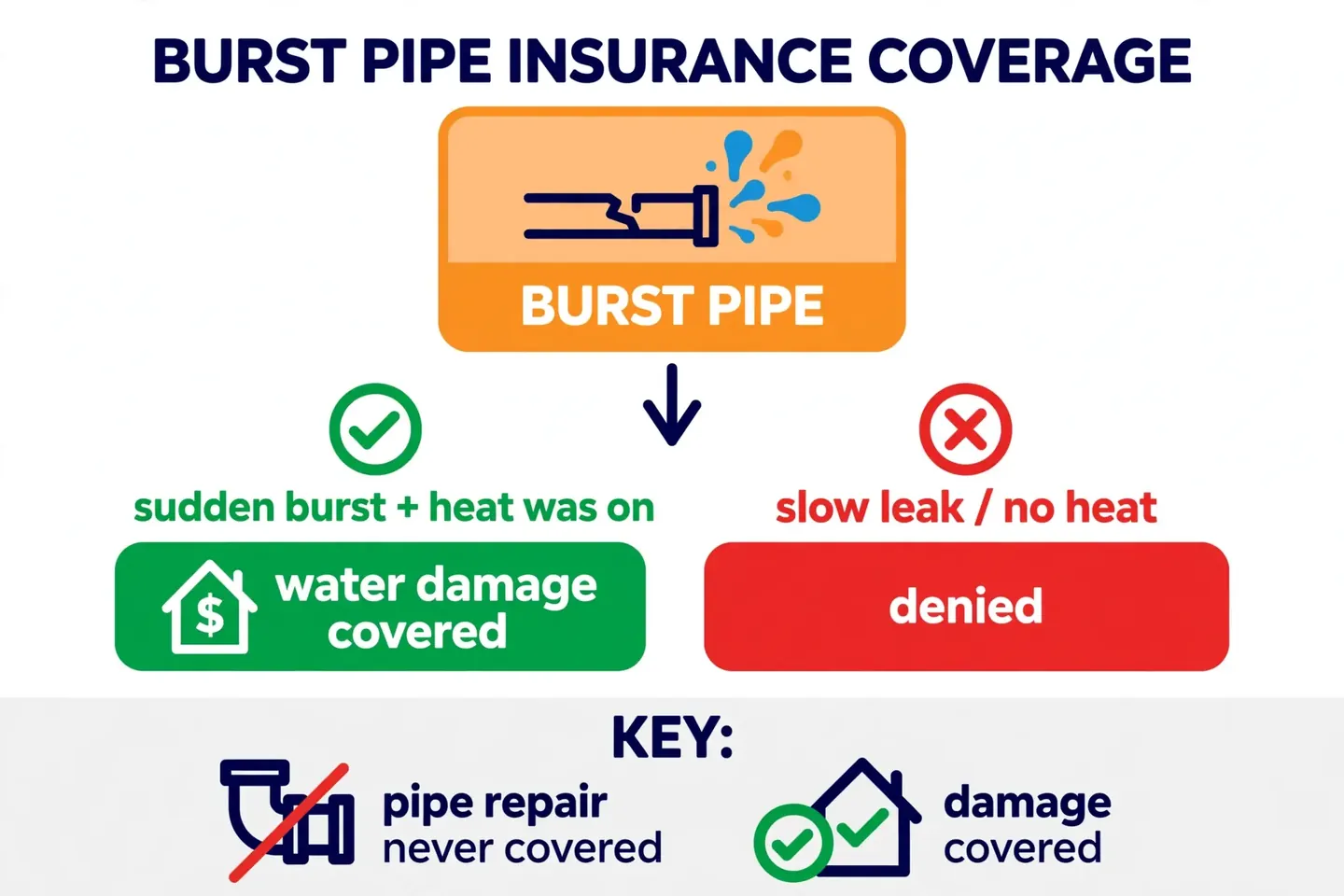
Standard homeowners insurance covers sudden and accidental water damage. A pipe that bursts without warning qualifies. But here is the split most homeowners do not expect:
Covered: Everything the water ruined. Drywall, flooring, ceilings, cabinets, furniture, rugs, electronics. The cost to tear out a wall to reach the broken pipe. Drying and dehumidification. If the damage makes your home unlivable, your policy's Loss of Use coverage pays for a hotel.
Not covered: The pipe repair itself. The plumber's invoice for fixing the burst section comes out of your pocket. This is not the adjuster being difficult. It is written directly into the standard policy form (ISO HO 00 03): the policy excludes "loss to the system or appliance from which the water or steam escaped." In plain English: insurance pays for what the water destroyed, not the plumbing that failed. They cover the flood, not the pipe. One practical tip from 20 years of writing these invoices: ask your plumber to itemize the bill separately, pipe repair on one line, water damage access and drying on another. The adjuster needs that split to process your claim.
The average water damage claim runs about $15,400 according to the Insurance Information Institute's 2019 to 2023 data (their older figure was $11,000, but post 2021 restoration costs pushed it up). Restoration alone, water extraction plus structural drying plus dehumidification, typically lands between $1,400 and $6,400. Your deductible, usually $500 to $1,000 for water claims, comes off the top.
The sudden vs gradual fight: where claims are won and lost
This is the number one reason burst pipe claims get denied. Your policy covers water that escapes suddenly. It excludes water that leaked gradually over weeks or months. Insurers know this line is where money is won and lost, and they lean on it hard.
You say: the pipe burst overnight and flooded the kitchen by morning. They say: that stain looks like it took months, so this was a slow leak you neglected. If there is any mold, they will point at it and argue mold takes weeks to grow, therefore the leak was gradual.
Here is what decides it: documentation of timing. Photos with timestamps. A plumber's written diagnosis stating the failure was sudden. Your own written timeline of when you first noticed water. The homeowner who can show "dry on Tuesday, flooded on Wednesday" wins. The homeowner with no photos and a vague "I think it happened sometime last week" loses. Document first, clean second.
What to do in the first hour (before you call anyone)
The order matters. Do this before the plumber arrives and before you call your insurer:
1. Stop the water. Main shutoff, now. Then open faucets to drain the lines.
2. Photograph everything before anything moves. Take a video and narrate it: "It is January 14th, water is coming from this joint here, the waterline on the wall is about six inches high." Photograph the broken pipe before the plumber touches it. Photograph every damaged room, every ruined item. These photos are your claim.
3. Call a local plumber, not the insurer's vendor. Get the emergency stopped and get a written invoice describing what failed and why. That invoice goes to your adjuster as evidence. If the insurer later sends their preferred contractor, remember that contractor works for the insurer's budget, not yours.
4. Mitigate. You have a legal duty to prevent further damage. Mop, shop vac, move dry items, get air moving. If you let water sit for three days and mold grows, the insurer will blame you for the mold. Mitigation receipts are part of the claim, so keep them.
5. Then call your insurer. Report promptly. Most policies require prompt notice, and delays give the adjuster room to argue the damage worsened on your watch.
Call your plumber before you call your insurer
This is the advice that saves people thousands, and almost nobody gives it. When you call your insurance company's claims line, even just to ask a question, that contact gets logged on your property's LexisNexis CLUE report. CLUE is the database almost every insurer checks when pricing your policy. That entry stays there permanently, even if you never file, even if the claim is denied, even if it pays zero. And it can raise your premiums.
The smarter order: shut off the water, document everything, get a plumber out to stop the damage and give you a written estimate. Then look at the numbers. If the damage is close to your deductible, or only slightly above it, think hard before filing. A $1,200 repair on a $1,000 deductible nets you $200 and a permanent CLUE entry. Get the professional assessment first, then decide whether the claim is worth it.
The 4 denial reasons (and how to beat each one)
"Gradual seepage, not sudden." The big one. Beat it with timestamped photos, the plumber's sudden-failure diagnosis, and your written timeline. If the insurer still pushes, a public adjuster (worth considering on claims over $10,000, they typically charge 10% of the recovery) knows how to fight this specific argument.
"Negligence / lack of maintenance." They will ask: did you leave the heat off? Did you ignore a known drip? For freeze bursts, the standard is "reasonable care," which generally means keeping the thermostat at 55°F or higher, or shutting off the water and draining the system if the house is empty. This is exactly why our frozen pipe prevention guide tells you to keep the heat at 55°F minimum. That advice is not just about pipes. It is about your claim.
"Wear and tear." In Hempstead's pre 1960 homes, insurers love this one. "The pipe was 70 years old, it was going to fail." Push back: age alone does not make a failure gradual. A 70 year old pipe that bursts on a January night is still a sudden event. The plumber's invoice describing a rupture, not corrosion seepage, is your evidence.
"Vacancy." Most policies limit or void coverage if the home sat empty for 30 to 60 days without winterizing. If you were away, document that the heat was on or the system was drained. A neighbor who checked the house is a witness. Put it in writing.
Frozen pipe claims have one extra rule
If the burst came from freezing, the insurer will ask what you did to prevent it. The policy exclusion for freeze damage has an exception: it does not apply if you used reasonable care to maintain heat, or if you shut off the water supply and drained the system. In plain terms: heat at 55°F or higher, or an empty house with drained pipes. Do one of those and document it, and the freeze exclusion cannot touch your claim. Do neither, and you handed them the denial.
The bottom line
A burst pipe claim is won or lost on three things: was it sudden, did you document it, and did you mitigate. The pipe repair is yours. Everything the water touched is the claim. Photograph before the plumber arrives, keep every receipt, and do not let anyone tell you a 70 year old pipe bursting on a January night was "gradual."
If you are reading this with water on the floor right now, stop reading and call +1 (516) 969-2004. We will stop the water, write you an invoice your adjuster can use, and tell you straight what to photograph before we start.