
Your boiler sat quiet all summer. Now October is here, and in about six weeks it will run harder than any other appliance in your house. Most Hempstead Village boilers are older than the people living with them. Cast iron steam units from the 1950s, oil fired workhorses, a few newer gas condensing models. They all need the same thing right now: attention before the first cold snap, not after.
Start it up before you need it
Do not wait for the first 35 degree night to find out your boiler has a problem. Turn the thermostat up 5 degrees above room temperature right now, in October, and let the system run a full cycle. Walk to every radiator and every baseboard. Feel for heat. Listen for banging, whistling, or gurgling. Smell for anything unusual near the unit. A boiler that starts clean in October is a boiler you can trust in January. One that coughs and bangs in October is telling you exactly what it will do on the coldest night of the year.
If it does not fire at all, check the obvious first: thermostat batteries, the emergency shutoff switch (usually a red switch plate at the top of the basement stairs, sometimes flipped off by accident over summer), and the circuit breaker. If those are fine and it still will not start, that is a service call, not a DIY project.
What a proper fall tune up includes
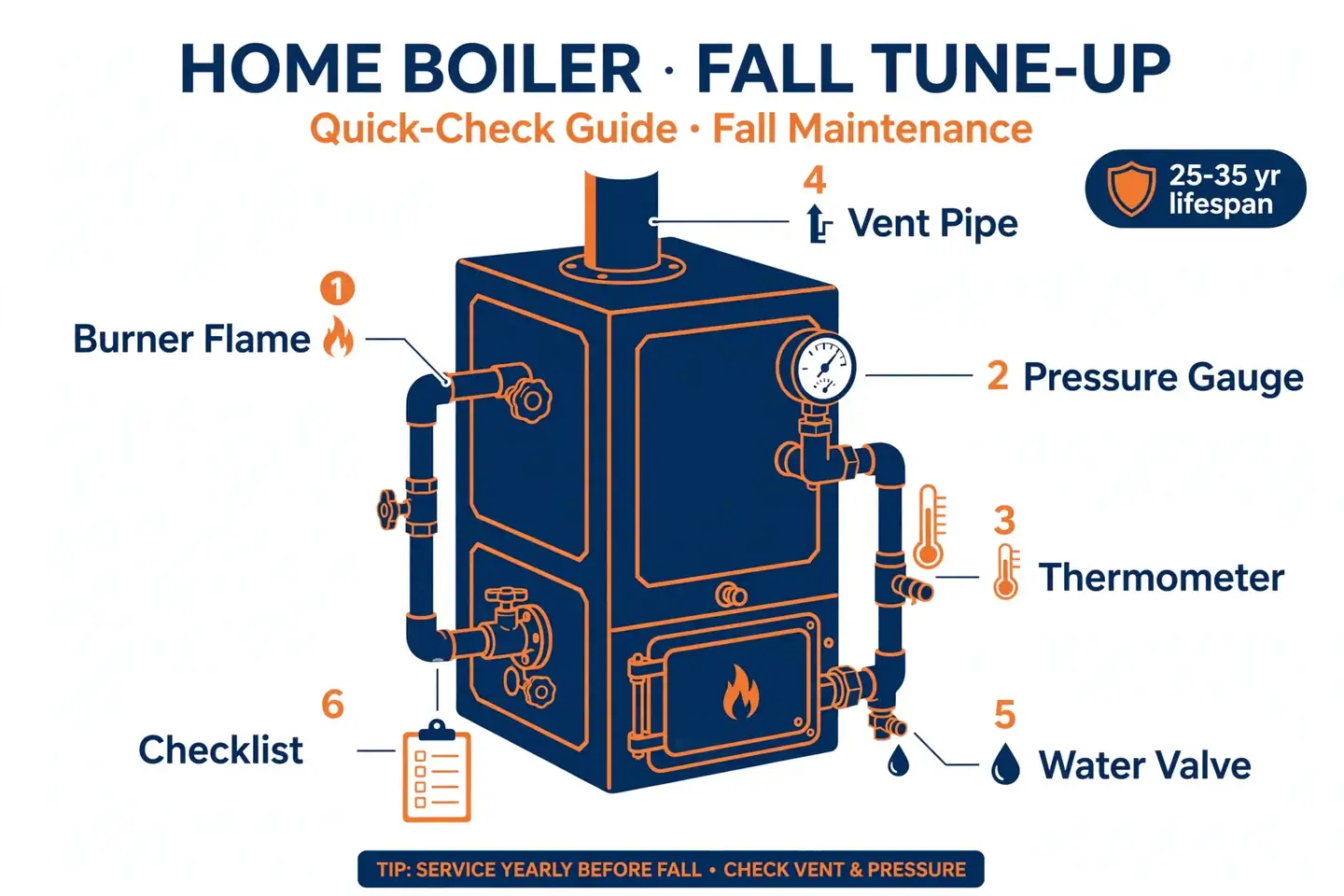
A professional boiler tune up takes 1 to 2 hours and typically runs $200 to $500 depending on the unit type and what it needs. Here is what should happen during one:
Burner cleaning and adjustment. Soot builds up on oil burners over a heating season. The tech cleans the nozzle assembly, replaces the fuel filter, checks the electrodes, and tunes combustion for efficiency. A dirty burner wastes fuel every single cycle.
Heat exchanger inspection. Cracks in a heat exchanger can leak carbon monoxide into your home. This is the safety check that matters most, and it is the one you cannot do yourself.
Carbon monoxide test. The tech measures CO levels at the unit and in the flue. Your CO detectors on each floor are the backup. Test them now. Replace batteries. A detector older than 7 years gets replaced, not just re batteried.
Pressure and expansion tank check. For hot water boilers, cold pressure should sit around 12 to 15 psi. The expansion tank absorbs pressure swings as water heats. A waterlogged expansion tank causes the relief valve to spit every cycle. The tech checks the tank charge and drains it if needed.
Relief valve test. Lift the lever briefly. Water should discharge and the valve should snap shut. A valve that drips afterward or will not open is a replacement item. This $20 part prevents catastrophic pressure buildup.
Vent and flue inspection. The tech checks the full vent path for blockages, corrosion, and proper draft. Bird nests in the flue cap over summer are more common than you would think.
Steam boilers: Hempstead's special case
A huge share of Village homes still run steam. If yours does, fall prep has a few extra steps:
Check the sight glass. The water level should sit at the marked line when the boiler is cold. Too low and the low water cutoff may trip, or worse, the boiler dry fires. Too high and you get water hammer and banging pipes.
Flush the low water cutoff. Open the blowdown valve weekly during heating season to flush sediment. Sediment buildup is the number one killer of low water cutoffs, and a failed cutoff on a steam boiler is genuinely dangerous.
Bleed the radiators. Air trapped in steam radiators causes banging and cold spots. Open each bleeder valve until steam (not air) comes out, then close it. Do this when the system is up to temperature.
Check the air vents. Each radiator has a small air vent that lets air escape as steam enters. A vent stuck open hisses constantly and wastes steam. A vent stuck closed means a cold radiator. They are $10 parts and take minutes to swap.
A Hempstead water warning for boiler owners. Our municipal water is highly corrosive (LSI negative 2.09). Every time you drain a boiler and refill it with fresh city water, you introduce dissolved oxygen that attacks the cast iron from the inside. If your system does not have a leak, do not drain it "just because." Top off only what is needed, and if your boiler needs frequent refilling, that is a leak to fix, not a maintenance routine. The oxygen pitting from repeated fresh water fills kills more Hempstead boilers than age does.
Oil tank: fill it and look at it
If you are still on oil, October is fill-up month. Do not go into winter on a quarter tank. Heating oil prices climb as demand rises, and running low risks sludge from the tank bottom clogging your fuel filter and nozzle mid January.
While the delivery driver is there, look at the tank itself. Rust streaks, wet spots underneath, or a strong oil smell in the basement are all "deal with this now" signals. An oil tank leak is an environmental problem, not just a heating problem, and cleanup costs dwarf replacement costs. If your tank is 20+ years old, start planning. One timing note: National Grid closed its gas heating equipment rebate program to new applications in 2026, so there is no rebate check coming to soften a new boiler purchase. That makes annual maintenance even more important. It is far cheaper to keep your current boiler alive than to replace it at full price. Our oil to gas conversion guide walks through the math if you are considering the switch.
The 10 minute homeowner check (do this monthly)
Between professional visits, spend 10 minutes a month during heating season:
Look at the pressure gauge. Listen for new noises. Check for water on the floor around the unit. Make sure the area around the boiler is clear, no boxes stacked against it, nothing flammable within a few feet. Glance at the flame through the sight port if your unit has one. It should be steady, not flickering wildly. And keep the thermostat at 55°F minimum even when you are away. That protects your pipes as much as your comfort.
The bottom line
A boiler tune up in October is the cheapest insurance in homeownership. Two hundred to five hundred dollars, one to two hours, and you head into winter knowing the heat exchanger is sound, the burner is clean, and the CO levels are safe. Skip it and you are gambling that a machine that sat idle for six months will run perfectly on the coldest night of the year.
Schedule it now, before everyone else remembers at the same time. Call +1 (516) 969-2004. We have been keeping Hempstead Village boilers running through Long Island winters for 20+ years.