
You turned on the faucet and got nothing. Or a sad little trickle. It is 15 degrees outside, and your stomach just dropped. Take a breath. If you are wondering what to do if pipes freeze, here is the answer in order: a frozen pipe is fixable if you handle the next 30 minutes right, and ruinous if you panic. Everything below is from a plumber who has thawed hundreds of these in Hempstead Village.
The first 5 minutes: stop the damage before you fix anything
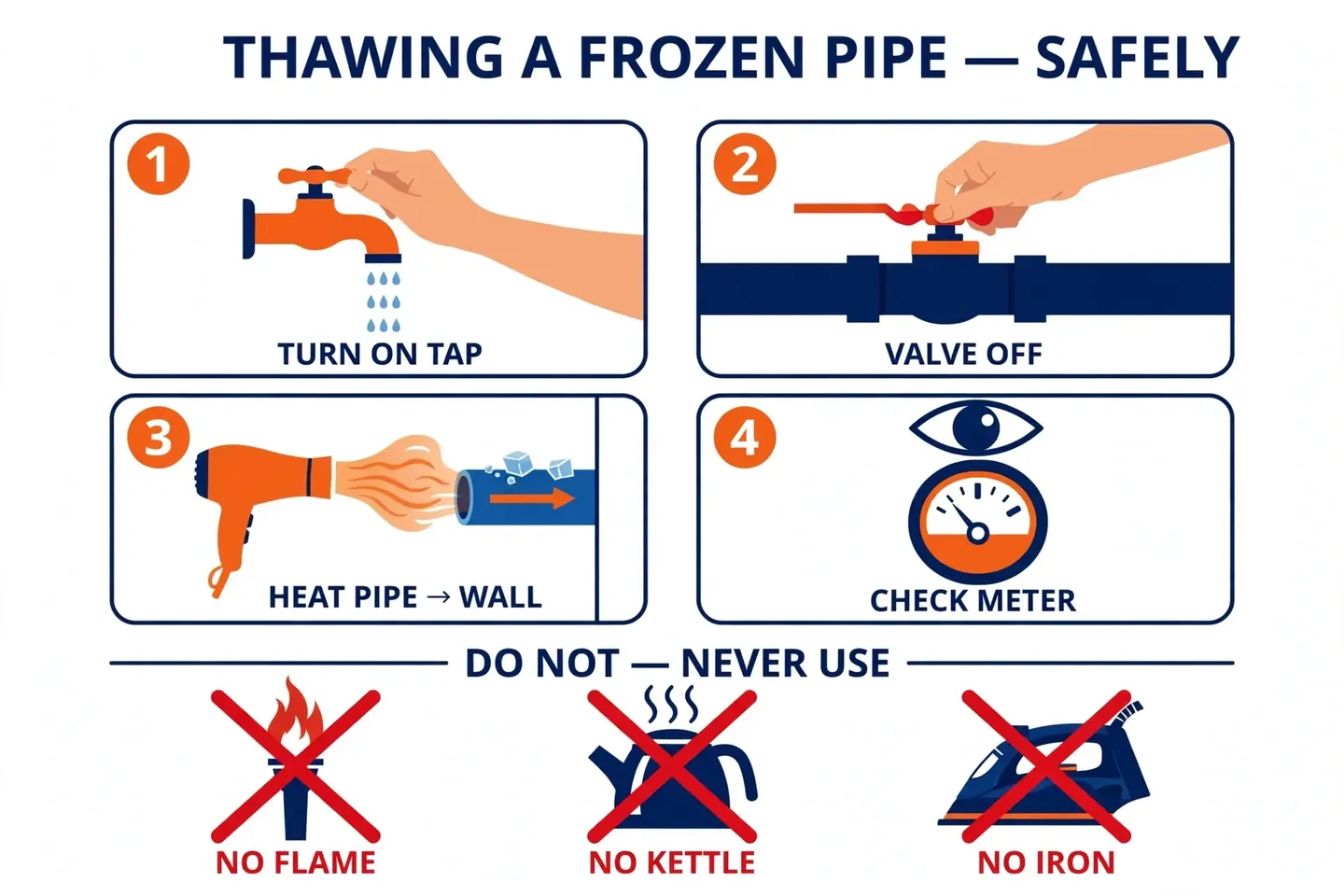
Step 1: Open the faucet. Go to the faucet the frozen pipe feeds and open it, cold side if it is a single handle. Leave it open. This is the single most important step and the one most people skip. As ice melts, water needs somewhere to go. A closed faucet traps pressure between the ice and the tap, and pressure is what bursts pipes, not the ice itself.
Step 2: Shut off your main water valve. Turn it off now, before you apply any heat. Here is why the pros insist on this: the ice plug inside your pipe is acting like a cork over any split that formed during the freeze. The moment that ice melts with full municipal pressure behind it, even a pinhole crack floods your wall cavity. With the main off, the residual pressure in your pipes is still enough to reveal a leak as a slow weep, without turning your wall into a waterfall. In most Hempstead homes the main shutoff is in the basement where the water line comes through the front wall. Turn it clockwise until it stops.
Step 3: Look before you heat. Check every faucet in the house. If only one is dead, the freeze is in the branch feeding that fixture. If several are dead, or the whole house, the freeze is closer to where water enters. Also look for the warning signs of a pipe that already burst: water stains on ceilings or walls, puddles with no obvious source, a hissing sound inside a wall, or a pipe section that looks swollen or bulged. If you see any of those, skip the DIY thawing below. Shut off the main and call +1 (516) 969-2004. That is emergency plumber territory.
How to tell if it is frozen or already burst
This distinction decides everything you do next.
Frozen (thaw it yourself): No water or a thin trickle from one faucet while others work fine. Frost visible on an exposed pipe. Clanking or whistling when you turn the tap. The pipe feels ice cold to the touch through a glove. No water anywhere it should not be.
Burst (stop and call): Water appearing where it should not be, stains spreading on drywall, paint bubbling, a musty smell that was not there yesterday, or your water meter spinning when nothing is running. Here is the tricky part: ice can temporarily plug a split. A pipe can be cracked right now and you will not know until it thaws. That is why step 2 above matters. If you thaw and water starts appearing, shut the main immediately.
How to thaw a frozen pipe safely, step by step
Only do this for pipes you can see and reach. Pipes inside finished walls, under slabs, or buried in insulation are a different job.
1. Hair dryer: the safest tool you own for this
Set it to medium heat, not high. Start at the faucet end of the frozen section and slowly work backward toward the coldest spot. Keep the dryer moving, never parked on one spot. You are warming the pipe, not cooking it. Keep the faucet open the whole time. You will hear sputtering, then a trickle, then full flow. That can take 30 minutes or a few hours depending on how long the freeze is. Patience is the method.
2. Warm towels: slow but steady
Soak towels in hot (not boiling) tap water, wring them out, and wrap the frozen section. Replace them as they cool. This works well for a short frozen run under a sink or in a crawl space you can reach. It is boring and it works.
3. Space heater: for the room, not the pipe
If the frozen pipe is in a cold garage, crawl space, or utility room, a portable electric heater warming the whole space can do the job. Keep it well away from anything flammable, keep it away from water, and never leave it running unattended. You are raising the room temperature, not aiming heat at the pipe.
4. Turn up the thermostat and open cabinets
If you suspect the freeze is inside a wall, crank the heat up a few degrees and open every cabinet door and interior door between the warm rooms and the cold wall. Do not cut into drywall yourself. If water does not return after several hours of this, the freeze is somewhere you cannot reach, and that is when you call us.
What NOT to do (the mistakes that cause fires and floods)
Never use an open flame. No propane torch, no blowtorch, no kerosene heater, no charcoal grill. This is not just dangerous, it is regulated: NFPA 51B classifies torch pipe thawing as hot work, the same category as welding. Copper pipe conducts torch heat straight into your wall framing, and insulation smolders for hours before bursting into flame. Every winter somewhere on Long Island a homeowner torches a pipe and the wall catches fire later that night. It is not worth it. Ever.
Do not pour boiling water on the pipe. The sudden temperature shock can crack copper and warp plastic. Warm towels, not boiling water.
Do not blast a heat gun on high. Heat guns get hot enough to melt PEX, weaken copper joints, and scorch wood framing before you notice. A hair dryer on medium is the ceiling for DIY heat.
Do not keep the faucet closed while heating. Closed faucet plus melting ice equals pressure spike equals burst. Open faucet. Always.
Do not use a clothes iron. This one surprises people because a major plumbing franchise actually suggested it online. Pressing a household iron against a metal pipe is an electrocution risk: if that pipe has a hidden split, water sprays directly onto a live 120V heating element. Stick to a hair dryer, which is designed to be held at a distance with airflow between you and the pipe.
Do not heat a bulging pipe. If a section looks swollen or misshapen, the pipe wall is already stressed to its limit. Adding heat can rupture it violently. Shut off the main and call a plumber.
After the water is flowing: the check most people skip
Water is back. Do not celebrate yet. Walk the whole path of that pipe and look for leaks, because ice hides splits. Check under sinks, along basement runs, behind the washing machine, anywhere the pipe travels. Then watch your water meter for an hour with everything off. If it moves, water is going somewhere it should not, and you have a leak to find. A frozen pipe repair that seemed fine at noon can become a ceiling stain by midnight.
Leaks show up in three waves. Most burst pipes reveal themselves within 2 hours of thawing, as soon as the ice plug melts off the split. But some pinhole cracks weep slowly inside the wall for 2 to 24 hours before the drywall shows a stain. And here is the one nobody expects: a pipe can survive the thaw with no leak, then split days or weeks later. Freezing stretches copper permanently, weakening it. A normal water hammer thump from your washing machine, weeks later, can finish the job. In Hempstead, where corrosive water has already thinned pipe walls, this delayed failure is more common than in newer neighborhoods.
Do the meter test. After thawing, turn off every faucet and water using appliance in the house. Go to your water meter (usually in the basement) and watch the small leak indicator dial for 15 to 30 minutes. If it moves at all with everything off, water is escaping somewhere. Call us before it becomes a ceiling stain.
Then fix the reason it froze. Insulate that run, seal the draft that let cold air in, or put heat tape on the section that always worries you. A pipe that froze once will freeze again. The full prevention walkthrough is in our frozen pipe prevention guide.
The bottom line
A frozen pipe is a race between you and pressure. Open the faucet, find the shutoff, warm it slowly from the faucet end, and never bring a flame near it. Most frozen pipes in Hempstead thaw fine with a hair dryer and patience. The ones that do not, or the ones that reveal a leak when they thaw, are why we answer the phone at 2 a.m.
If you are staring at a dead faucet right now and want a pro to handle it, call +1 (516) 969-2004. We have been thawing Hempstead Village pipes for 20+ years, and we will tell you straight whether it is a DIY job or a truck roll.